
a voce sola
[...] a much-needed recording, capable of restoring dignity to a musician whom fate — and the lax philological approach of too many centuries — had relegated to the margins.
A. Cammarano, Le Salon Musical
a voce sola is far more than a simple recording: it is the result of a long process of research, listening and dialogue within a working group united by a shared artistic vision.
The album is entirely devoted to the solo motets of Alessandro Grandi, a central yet still insufficiently known figure of the early Italian seventeenth century, whose music combines expressive refinement with remarkable formal boldness. At the heart of this project lies an in-depth process of transcription from the original sources, carried out with strict philological rigour. The selected works — some of which have never been performed in the modern era — were studied with great care, discussed collectively, and brought back to life through the use of original instruments and historically informed performance practice.
a voce sola is also a living laboratory: each interpretation emerges from the dialogue between the musicians, from a shared creative process in which research and artistic freedom are in constant interplay.
L’Accademia degli Affetti works in close synergy, with the aim not merely of “reproducing” the past, but of restoring its breath and presence, while preserving the full communicative power of these works.
With this recording, the ensemble seeks to give voice — quite literally — to a precious and still surprising repertoire, returning it to listeners not as a museum object, but as a living expression of an era that still has much to say.
This is not merely a recording: it is a rediscovery, an act of restitution and of love towards a musical heritage that remains largely unexplored.
Speaking of...
[...] the strings of the Accademia degli Affetti do not merely accompany; they engage in dialogue.
Maria Chiara Ardolino approaches the repertoire with a dry tone, showing little inclination towards decorative vibrato, which allows the Latin text to breathe without suffocating it with artificial emotion. [...]
[...] The basso continuo, understated yet never anonymous, and the sound quality — clean, with a spatial quality that does not drown out the details — round off a work that has the rare merit of presenting a composer without ‘restoring’ him: Grandi reaches us with his rough edges intact, not smoothed over to please the contemporary ear. [...]
Alessandro Cammarano, Le Salon Musical - leggi l'articolo completo

At the heart of the project lies the figure of Alessandro Grandi, a composer often regarded as “minor” in comparison with his contemporaries, yet one who proves to be of considerable musical interest. His compositions, predominantly sacred, are particularly compelling for their significant use of obbligato instruments: in effect, the very beginnings of the concertato style, which would flourish in the second half of the seventeenth century.
The programme focuses on the three books of motets with instruments published in Venice between 1621 and 1637. To a large extent, the motets presented here are previously unpublished and receive their first performances in modern times.
The transcription of the motets was undertaken by Maria Chiara Ardolino. The sources consulted are preserved at the International Museum and Library of Music of Bologna and the Bibliothèque nationale de France.
Below you will find the full video of the interview for StoryTime Padova.
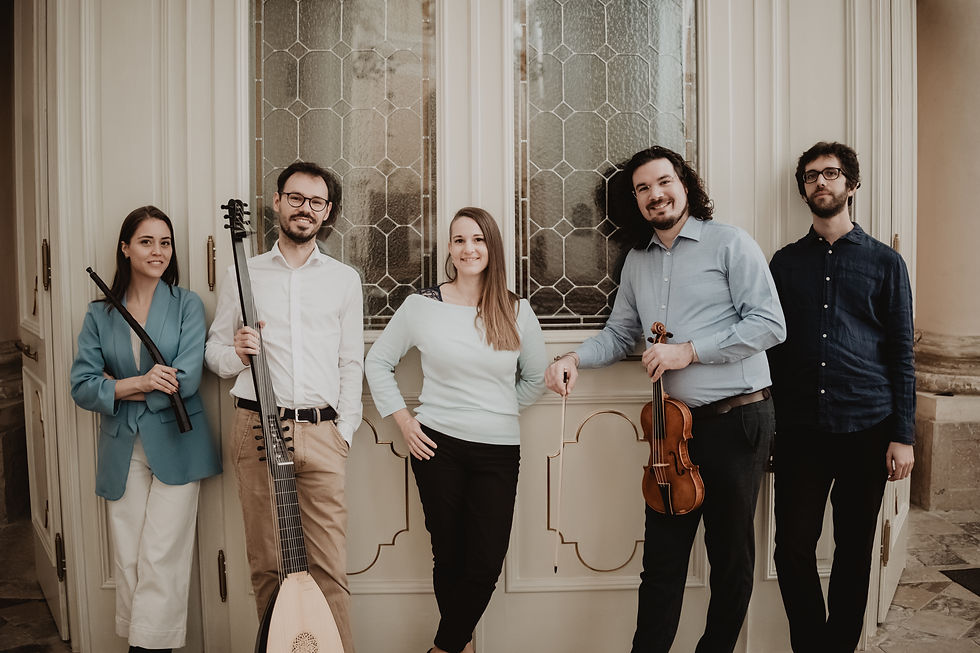
Founded in 2024 on the occasion of this recording project, the ensemble brings together five musicians united by the pursuit of a perfect balance between word, sound and proportion — an ideal that echoes the golden ratio, a symbolic and inspirational hallmark of the group.
The ensemble’s aim is to recreate and explore the musical practices typical of seventeenth-century academies, investigating the innovations of the early Baroque with particular attention to dialogue among equals and to the creative exchange that characterised those artistic circles.
Formed by soprano, violin, cornett, theorbo and organ, the ensemble explores Italian and European repertoires of the early seventeenth century, a period of profound stylistic and spiritual transformation. The approach adopted by the Accademia combines fidelity to historical sources with a contemporary sensitivity to colour and musical gesture, restoring to audiences the vitality and poetry of a language in constant evolution.
Through recording projects and concerts, the ensemble seeks to bring rare pages and forgotten masterpieces back to light, interpreting them with rigour, creativity and sonic imagination.
Get in touch to bring a concert to your city!


He was born in Venice in 1590 and died of the plague in Bergamo in 1630, at only forty years of age. In 1604 he was elected giovine di choro at St Mark’s Chapel. Despite an official regulation setting the minimum age at twenty, the young Alessandro was put forward for a ballot and elected on the strength of his outstanding musical and compositional abilities.
During his years at St Mark’s, Grandi had the opportunity to study with Giovanni Croce (Maestro di Cappella from 1603 to 1609), Giovanni Gabrieli (first organist from 1585 to 1612), and Claudio Monteverdi (Maestro di Cappella from 1613 to 1644).
In 1609 he abandoned his ecclesiastical career and moved to Ferrara, where he became Maestro di Cappella of the Accademia dello Spirito Santo. In 1614 he entered into contact with the Accademia degli Intrepidi, for which he composed a book of madrigals (published in 1615). In 1615 he was appointed Maestro di Cappella of the Accademia della Morte (rivals of the Spirito Santo), and in 1616 he became Maestro di Cappella of the Cathedral, a position he held until 1617, when he returned to Venice.
His ties with the lagoon city had in fact never been completely severed: in 1613 he returned to Venice to marry Lucia Archieri, and the collections published by Vincenti between 1613 and 1616 helped to keep Grandi’s reputation high in the city. As a result, in 1617 he returned permanently to Venice as a singer at the Ducal Chapel. In 1618 he became singing master to the students of the Seminary, and on 17 November 1620 he was appointed Vice-Maestro di Cappella, a post he retained until 1625, when he suddenly decided to withdraw from the Marcian scene.
Thanks to the protection of Francesco Duodo, in 1627 Grandi obtained the prestigious position of Maestro di Cappella of the Basilica of Santa Maria Maggiore in Bergamo, where he remained until his death in 1630.
Grandi’s catalogue is extensive: it comprises six collections of secular music and fifteen collections of sacred music, the majority of which consist of motets for one, two or three voices. Several of these books include obbligato upper instruments: the first and second books refer simply to instruments, while the third specifies two violins.
The concertato style
The term concerto does not denote a genre or formal structure, but rather an organisational and performance attitude, characterised by the contrast between voices and instruments. This approach developed throughout the seventeenth century to such an extent that, at the beginning of the eighteenth century, Lodovico Casali defined the concertato character as “indispensable”, identifying it with the essential coexistence of voices and instruments.
This practice can be divided into three principal aspects:
-
the alternation, within the same composition, of different timbral forces (voices, instruments, or voices and instruments together);
-
the alternation of volume and texture (solo versus tutti);
-
the alternation of sections within the same composition or work (a cappella passages, recitatives, arioso, cantabile sections, etc.).
The motets by Grandi examined in this project belong primarily to the first category. Almost all of them feature an alternation between instrumental ritornellos and sung sections accompanied solely by basso continuo, culminating in a final tutti in which voice and obbligato instruments engage in close dialogue.
Variety and contrast, collaboration and interaction, surprise and alternation lie at the heart of the concept of concerto—a practice already established in the sixteenth century, which developed extensively at St Mark’s in Venice with the Gabrieli family, and which reached its fullest expression in the seventeenth century, also thanks to the parallel development of opera and solo vocal cantatas.
This project focuses in particular on solo vocal motets (soprano) with obbligato upper instruments, selected from the three books of motets explicitly devoted to this repertoire. Only motets specifically written for soprano voice have been considered, and the transcription work has been carried out directly from the original prints preserved at the International Museum and Library of Music of Bologna.
The transcription work is forthcoming and will be published in due course.